US Real Estate Forecast: Next 5 Years of Housing Trends
April 1, 2026
6 Minutes
Still thinking about “waiting out” the housing market? Here’s what current data suggests: every year you delay, affordability declines and your long-term costs climb. Prices aren’t crashing, insurance isn’t slowing, and construction costs are still outpacing income growth.
This guide breaks down 2026–2030 projections so you can decide whether buying now protects your future, or whether waiting will may reduce affordability over time.
2026-2030 at a Glance: Will Homes Get Cheaper or More Expensive?
If you’re hoping for a 2008-style reset, the data shows the opposite. Here’s the real 5-year outlook:
- No national crash ahead, analysts expect a long plateau with slow but persistent price creep.
- Construction costs + insurance are rising faster than wages, tightening affordability even in “stable” markets.
- Mortgage rates may ease, but history shows that lower rates pull demand up, often pushing home prices higher, not lower.
- Texas & Florida stay demand magnets, but climate-driven insurance spikes increase the true monthly cost of ownership.
- Net outcome: For most first-time buyers, 2025–2027 is the last reasonably affordable window before 2028–2030 cost pressures stack up.
Why Waiting Hurts
If a $400,000 home grows just 2.5%/yr, waiting until 2030 means paying:
- $456,000 for the same home
- ≈ $56,000 in price increase alone
Higher insurance + higher taxes = $200–$350 more per month
Every year of waiting = equity you never recover.
Thinking about buying in the next 5 years?
Start your pre-approval process with reAlpha Mortgage to see exactly what price range still works for you before affordability slips further.
Bundle your agent and mortgage. Save an average of $10,000.
Don't have an agent yet? Pair your reAlpha mortgage with a reAlpha agent, and you could get up to 1.5% cash back at closing.
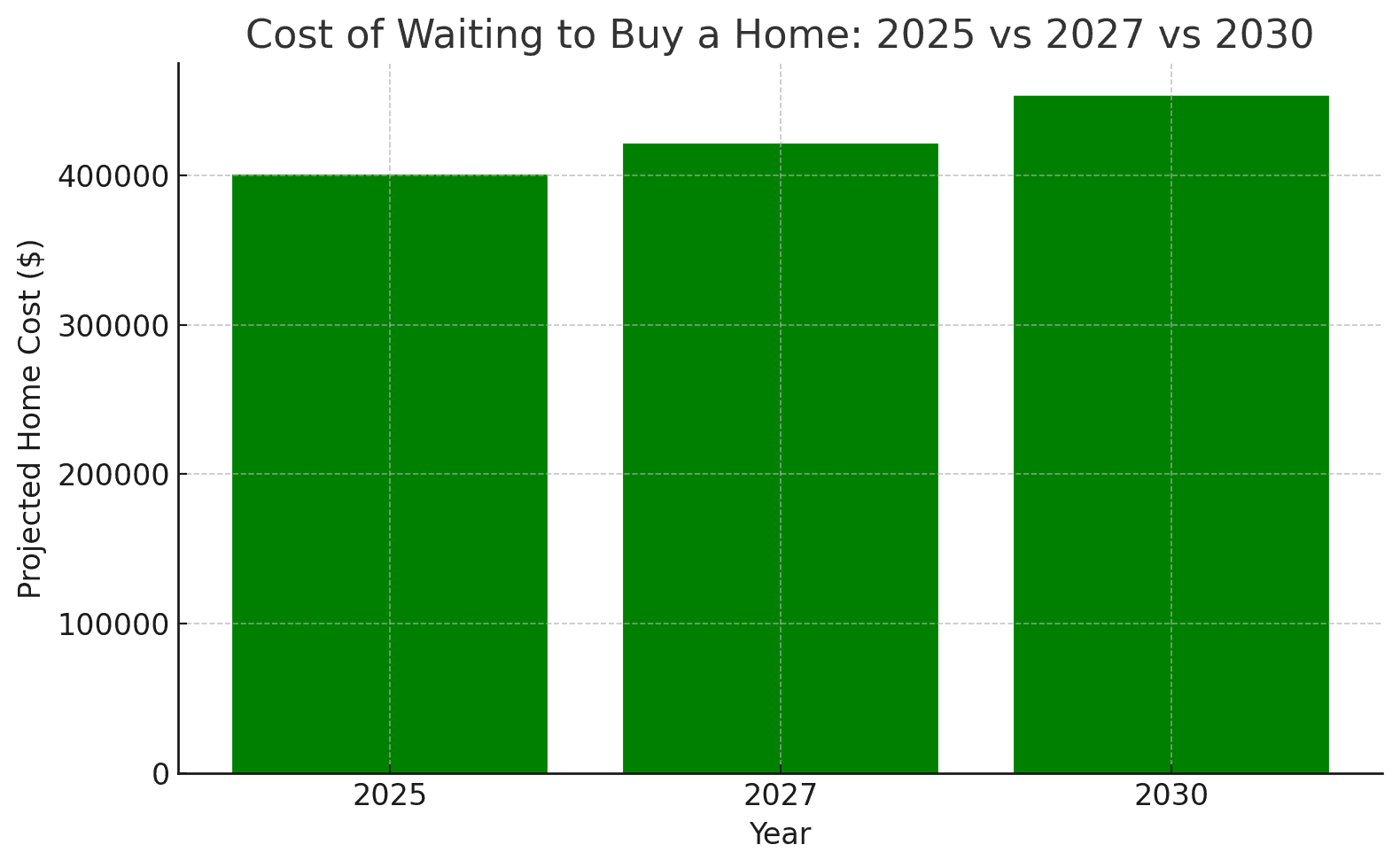
Even if prices only rise 2–3% per year, waiting until 2030 can add tens of thousands of dollars in total cost. That’s before factoring in rising insurance and climate risk in many states.
Check your max budget with our Affordability Calculator.
Get pre-approved and understand your buying power with reAlpha Mortgage.
How the Next 5 Years Are Forecasted
You deserve a forecast built on real signals, not guesswork. That’s why this 2026–2030 outlook uses broad ranges and directional trends-not rigid numbers-so buyers aren’t misled by false precision. Think of this as a probability map, not a guarantee, based on the most influential housing forces shaping the next cycle.
Our Forecast Uses Three Layers of Inputs
- Macro Inputs: Inflation ranges, wage growth trends, evolving Fed rate expectations, and national demographic demand patterns.
- Housing-Specific Indicators: Inventory levels across major metros, new-construction pipeline momentum, and the general direction of material + labor costs.
- Local Overlays (TX & FL Emphasis): Insurance conditions, climate-risk adjustments, and migration patterns that can shift affordability faster than national data reflects.
Key Assumptions
To keep the forecast realistic and adaptable, we rely on average ranges rather than fixed values, leaving room for the market to move without breaking the model.
Here’s what guides our projections:
- Annual home appreciation: general upward drift within a moderate range
- Mortgage rate band: directional movement rather than a single point estimate
- Insurance + tax pressures: expected to trend upward, but within broad variability
- Construction cost trajectory: continued elevation with typical year-to-year swings
- Migration demand: strong but regionally uneven across TX & FL
National Home Price Forecast: 2026–2030
The next five years won’t deliver fireworks or a meltdown, just a slow, steady tightening of affordability. National home prices are expected to move through two distinct phases:
2026–2027: The “Slow Grind” Years
- Expect modest price appreciation as inventory remains tight.
- Mortgage rates may ease into a more moderate band, but not enough to create a true affordability reset.
- Buyers who enter during this window get the advantage of less competition and more negotiating room.
2028–2030: The Re-Acceleration Window
- If rates stabilize lower than the 2023–2024 peaks, demand could surge again.
- Even small declines in rates historically lead to price jumps, not drops, because sidelined buyers re-enter the market all at once.
- Combined with insurance and construction pressures, this period could push monthly payments up even if appreciation remains moderate.
Bottom line: The earlier years favor buyers; the later years favor the market.
Will the Housing Market Crash by 2030?
Short answer: Highly unlikely.
Most experts see the next cycle as a patchwork of regional corrections, not a dramatic nationwide collapse like 2008. The structural shortages, demographic demand, and tighter lending standards simply don’t support a crash scenario.
The real threat to first-time buyers isn’t a cliff - it’s gradual increases over time Small annual price bumps, rising insurance premiums, property taxes creeping up, and maintenance costs inflated by ongoing labor shortages. None of these feels dramatic in isolation, but together they slowly push more buyers out of contention.
And unlike a crash, these incremental increases don’t reverse.
A tiny 2–3% yearly increase seems harmless until you stack it across five years. A home that drifts upward slowly still ends up tens of thousands more expensive, before you factor in rising insurance and tax loads.
Waiting for a crash?
Instead of timing the market, focus on timing your life. Get pre-approved and see what buying now looks like vs waiting: Get Pre-Approved.
Buying a Home? Get up to 1.5% Cash Back at Closing
Get pre-approved first, then start exploring homes knowing you can receive up to 1.5% of the home price back at closing.

Why Construction Costs & Insurance Matter More Than Ever
Most buyers focus on the home price, but the true cost of owning a home in 2026–2030 will be shaped by forces happening behind the scenes: labor shortages, rising material costs, regulatory friction, and insurance volatility. These are the quiet drivers that keep homes from becoming “cheap again,” even in years when price growth slows.
Labor + Materials Inflation
Construction trades continue operating with fewer workers than demand requires, and materials remain tied to global supply cycles. The result? Consistent upward pressure on cost to build a house, which limits how far prices can fall-even in cooling markets.
Regulatory & Zoning Constraints
Many metros still restrict density, delay permitting, or require costly compliance steps. These slowdowns add time and expense, discouraging builders from producing entry-level homes.
Insurance Spikes in Climate-Exposed States
Coastal Florida, parts of Texas, and other risk zones face steep upward pressure on premiums. Even if home prices plateau, insurance alone can increase your monthly payment every year, eating affordability from the inside out.
Insurance, Weather & Climate Risk
Insurance is becoming one of the fastest-moving variables in homeownership. Hurricanes, flooding, hailstorms, wildfires, and increasingly unpredictable climate events have pushed some carriers to exit ZIP codes entirely in states like Florida and Texas.
When insurers retreat, premiums rise. When premiums rise, your total monthly cost goes up even if your mortgage doesn’t.
This is the hidden danger of waiting:
Prices might flatten-but your total monthly cost may still climb due to insurance, taxes, and maintenance tied to climate-driven risks.
Want to know your realistic monthly cost?
Use our Mortgage Calculator to estimate your payment with taxes and insurance.
Housing Affordability 2026–2030: Getting Better or Worse?
Affordability isn’t just about the sticker price of a home - it’s the relationship between your income and your total monthly housing cost (mortgage, insurance, taxes, utilities, maintenance). And from 2026–2030, those costs continue rising faster than most household incomes.
Even if home prices cool or move sideways, affordability can still decline because:
- Wage growth drifts upward slowly, while major housing costs rise in wider, less predictable bands.
- Rents continue climbing, pushing more buyers into the same pool of available homes.
- Insurance + tax pressures add to the monthly payment even when prices remain stable.
- Interest rate movements change what you can actually afford far more than price shifts do.
Affordability doesn’t collapse all at once - it erodes gradually, one monthly cost at a time.
What Waiting Actually Costs You
To understand the real consequences of delaying your purchase, imagine two buyers:
Buyer A - Buys in 2026
- Begins building equity immediately
- Locks in a stable monthly payment
- Benefits from potential rate drops via refinance later
- Avoids future insurance + tax escalations in more competitive markets
Buyer B - Waits until 2030
- Faces higher baseline home values (even with modest yearly increases)
- Pays higher cumulative interest because of a larger loan amount
- Enters the market after multiple years of insurance and tax inflation
- Misses out on five full years of equity growth
Simple Math Snapshot
(Conceptual - no fixed numbers)
- Equity Built: Buyer A gains multiple years of principal reduction + appreciation
- Total Interest Paid: Buyer B pays more interest on a larger loan
- Total Cash Out of Pocket: Buyer B faces higher upfront costs + higher monthly costs
Small annual increases compound into tens of thousands of dollars lost - and those losses never come back.
Should I Buy a House Now or Wait Until 2028–2030?
If you’re stuck between “buy now” and “wait it out,” here’s the truth: the right move depends on your timeline, stability, and the cost of waiting in your market. Use this quick quiz-style framework:
- Strong job + income stability? → Lean toward buying sooner to lock in predictable housing costs.
- Rent rising fast in your city? → Buying sooner often saves more because rent inflation compounds, eating your budget every year.
- Living in TX or FL with insurance rising yearly? → Buying earlier can secure a lower baseline before premiums climb into new bands.
- Unsure about staying put for 1–2 years? → Renting may make sense until your life timeline stabilizes.
- Planning a big move, remote role, or relocation? → More flexibility = more time to shop undervalued metros before demand surges in 2028–2030.
The goal isn’t timing the market - it’s timing your life before affordability erodes further.
Buy-Now vs Wait Scenarios (2026–2030)
| Scenario | What 2026–2030 Looks Like | Risk of Waiting | Action Step |
|---|---|---|---|
| First-time buyer in TX/FL | Rising insurance + steady demand | High | Get pre-approved + buy smart early |
| Move-up buyer with equity | Existing equity softens higher prices | Medium | Sell strategically, buy sooner |
| Remote worker, flexible move | Many “undervalued” metros are still available | Medium | Explore undervalued markets before they heat up |
| Investor | Rents + prices trending upward in strong job metros | Varies | Focus on yield, cash flow, and location |
Waiting until 2028–2030 often means:
- Higher insurance baselines
- Higher rent erosion (lost savings)
- Higher entry price, even with modest appreciation
- Fewer affordable ZIP codes in TX & FL
Small delays = large long-term cost penalties.
Don’t let “planning” become your excuse for missing your window.
You can begin by:
- Check your max budget with our Affordability Calculator
- Get pre-approved with reAlpha Mortgage.
- Start exploring homes within your budget range at home search tools
A Smarter Way to Buy a Home - and Save at Closing
Buying a home is a big decision - and having the right information puts you ahead. Butan added benefit comes from pairing smart research with a smarter way to buy.
When you use a reAlpha you can be eligible to receive up to 1% of the home purchase price back as a cash back at closing. Add reAlpha Mortgage, and that cash back at closing can increase to up to 1.5% back, helping offset closing costs and keep more money in your pocket when it matters most.
The Cashback is simple, transparent, and applied directly at closing - no complicated hoops, no delayed payouts. Just cash back at closing tied to using a one platform.
See how much you could save:
- Check your eligibility
- Explore homes that fit your budget today.
- Your next move could come with cash back at closing.
FAQs
1. Will housing prices drop between 2026 and 2030?
A major nationwide drop is unlikely. Most projections point to mild year-to-year increases driven by limited inventory, high construction costs, and steady demand. Some overheated markets may see small corrections, but not the kind of reset buyers are hoping for. The bigger risk is waiting while affordability keeps slipping.
2. Is it better to buy a house now or wait for a housing market crash?
Waiting for a 2008-style crash is usually a losing strategy. Experts expect localized dips, not a national collapse. Meanwhile, insurance, taxes, and rents continue rising each year. For many buyers, the cost of waiting outweighs the chance of catching a rare crash. Buying sooner often protects long-term affordability.
3. How much will my house be worth in 2030?
Most forecasts expect steady appreciation through 2030, not explosive growth-but enough to significantly increase equity over five years. Exact values vary by state, insurance trends, and local job growth. What’s predictable is the pattern: homes purchased earlier typically gain thousands more in equity than those purchased later.
4. Will construction costs and insurance keep going up?
Most indicators say yes. Construction costs have historically risen faster than general inflation, and climate-related insurance pressure continues in states like Florida and Texas. Even if home prices flatten, these non-price factors can make ownership more expensive every year, pushing affordability down.
5. How can I reduce my homebuying cost if prices aren’t coming down?
You can’t control market prices, but you can control your transactions. Bundling reAlpha Realty + Mortgage + Title helps unlock meaningful savings through optimized loan structures and reduced frictional costs. These efficiencies effectively make your home more affordable, even when the market doesn’t.
Get the latest market trends, homebuying tips, and insider updates—straight to your inbox. No fluff, just the good stuff.
Article by
As a great communicator with excellent negotiation skills, I focus more on establishing unbreakable ties between my clients, as opposed to just helping them achieve their real estate dreams. As a representative of both buyers and sellers, I understand how to lead a transaction process to ensure that the needs of both are met. My track record speaks for itself. Since I ventured into the industry in 2013 as a realtor, I have not only helped many buyers land perfect homes, but I have also assisted tons of owners and investors build wealth.