August 2, 2026
14 minutes
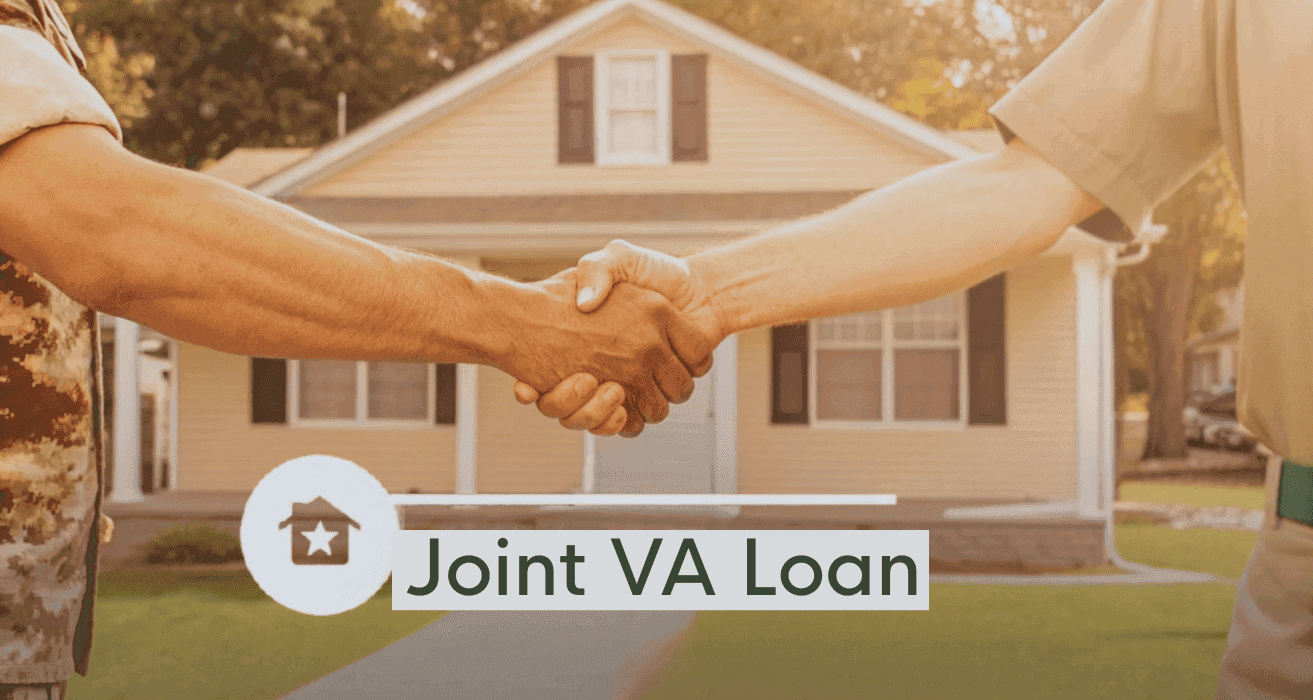
You have a co-borrower in mind and a VA benefit you want to use. Here's what changes when those two things meet.
The short answer: yes, a joint VA loan is possible. The longer answer depends entirely on who your co-borrower is. Whether you're buying with another Veteran, a non-Veteran spouse, or a civilian partner, the rules - and the costs - shift in ways most articles don't fully explain. This guide walks through all three scenarios so you know exactly where you stand before you talk to a lender
What Is a Joint VA Loan?
A joint VA loan is a home loan that uses VA benefits where a second borrower is also on the note. That co-borrower can be a spouse, another Veteran, or a civilian with no military connection at all. The loan uses the VA guarantee - the government's promise to repay a portion of the loan if the borrower defaults - which is what enables most VA loans to close with no down payment.
The critical point: not all joint VA loans work the same way. Who your co-borrower is determines how much of the loan the VA guarantees, whether a down payment is required, and how the funding fee is calculated. Getting that wrong before you start can cost you thousands.
The Three Joint VA Loan Scenarios
Most content on this topic covers one scenario - the Veteran + non-Veteran spouse - and treats it as the whole picture. It isn't. Here are the three configurations that actually exist, what each means for your loan, and where the math matters most.
Veteran + Veteran (Dual-Entitlement)
Two Veterans buying together is the most favorable joint VA loan scenario. Each Veteran brings their own entitlement to the transaction.
VA entitlement is the dollar amount the VA guarantees on your behalf - in most counties, that's up to $144,000 in basic entitlement, with bonus entitlement bringing the effective guarantee to 25% of the conforming loan limit (Source: VA.gov, 2026). When two Veterans pool their entitlement on a single purchase, the combined guarantee can cover the full 25% of the loan amount the VA requires - meaning no down payment in most cases.
One application. 100+ lenders.
reAlpha Mortgage shops a network of lenders to find the right loan for your situation-no rate-shopping required.

The funding fee applies to each Veteran borrower individually, based on their own usage history. A first-time VA loan user pays a lower funding fee than someone using the benefit a second time. If either Veteran receives VA disability compensation, they are exempt from the funding fee entirely (Source: VA.gov - VA Funding Fee and Loan Closing Costs).
This configuration is the one buried or missing in most SERP content. If you and your co-buyer are both Veterans, lead with this - it's structurally the strongest option available.
Veteran + Non-Veteran Spouse
When you buy with a non-Veteran spouse, the VA guarantee applies to the full loan - not just your half. When you buy with a non-Veteran spouse, the VA still guarantees the full loan. The non-Veteran status of one borrower doesn't reduce the guarantee - the VA treats a married couple as one borrowing unit for this purpose.
The practical result: no down payment is required assuming full entitlement is available, and mortgage insurance is not required (a VA program feature, not something reAlpha provides). Your spouse's income and credit history factor into lender approval, which is often a net positive for qualification - two income streams strengthen the file.
The funding fee applies only to the Veteran borrower. The spouse's non-Veteran status doesn't generate a second fee.
One note: if the non-Veteran spouse is the sole borrower on any part of the transaction, the VA guarantee does not extend to that portion. In a standard joint purchase where both names are on the loan, this isn't an issue. Confirm the loan structure with your reAlpha Mortgage loan officer before assuming.
Veteran + Civilian Non-Spouse Co-Borrower
This is the scenario that generates the most confusion - and the most lender runaround. It's also the one where the most expensive surprise happens.
When your co-borrower is a civilian with no military connection and no spousal relationship to you, the VA only guarantees the Veteran's portion of the loan. Typically, that means the VA guarantee covers 50% of the purchase - the Veteran's share - while the civilian's 50% is treated like a conventional loan. That portion requires a down payment.
Here's what that looks like in practice:
A Veteran buying a $400,000 home with a civilian co-borrower: the VA guarantees the Veteran's $200,000 share is not VA-covered. At a standard 10% down payment requirement on the non-VA portion, that's $20,000 in cash needed at closing.
A reAlpha Mortgage loan officer recently worked with a Veteran purchasing a $450,000 home in Texas alongside a civilian co-borrower. The Veteran assumed the $0 down benefit applied to the full purchase. It didn't. The required down payment on the civilian's share - calculated on the non-VA-guaranteed portion - came out to $22,500. That number surfaced two weeks before closing. Understanding the structure at the start would have given the buyer time to plan.
The funding fee in this configuration applies only to the Veteran borrower. The civilian co-borrower does not pay a VA funding fee - they are simply treated as a conventional borrower on their portion of the loan.
How VA Loan Entitlement Works With a Co-Borrower
Entitlement is the dollar amount the VA guarantees on a Veteran's behalf. It's what makes the VA loan program work without mortgage insurance or a down payment in most cases.
There are two layers: basic entitlement ($36,000) and bonus entitlement (also called second-tier or remaining entitlement), which together allow the VA to guarantee up to 25% of the conforming loan limit for your county. In most U.S. counties, the 2026 conforming loan limit is $832,750, which means the VA can guarantee up to $208,187 on a zero-down loan. In high-cost counties, limits are higher (Source: FHFA, 2026 CLL announcement).
Full entitlement means the Veteran has never used their VA benefit before, or has paid off a prior VA loan in full and had the entitlement restored. Full entitlement allows the VA to guarantee the full required 25% of any loan amount with no down payment.
Remaining (partial) entitlement occurs when a Veteran has an active VA loan or used entitlement that hasn't been restored. In this case, the VA guarantee on a new loan is limited to whatever entitlement is left. If the remaining entitlement doesn't cover 25% of the new loan amount, a down payment on the gap may be required.
In a joint VA loan between two Veterans, each brings their own entitlement to the table. The two guarantees are combined, which is why the dual-Veteran scenario is the strongest.
Entitlement is a VA program benefit - reAlpha helps Veterans use it, not provide it." The current text is factually safe but a less careful writer could have written "reAlpha uses your entitlement to cover your share. The civilian's share sits outside the VA guarantee entirely, which is what triggers the down payment requirement described in the previous section.
Get Pre-Qualified and Save Up to 1.5% at Closing with reAlpha
Save up to 1.5% at closing when you combine real estate and mortgage services with reAlpha.
What Lenders Look at When Two Borrowers Are on a VA Loan
Here's what most VA loan guides skip: when two people are on the loan, the lender typically underwrites to the lower middle score - not the higher one.
When two people are on the loan, the lender evaluates both files. That means:
Credit score: Most lenders qualifying for VA loans look at the lower middle score between the two borrowers. If the Veteran has a 720 and the civilian co-borrower has a 640, many lenders will underwrite to the 640. Some lenders set their VA minimum at 580; others at 620 or 640. A small number approve files with scores in the 550-580 range with strong compensating factors - this is lender-specific and subject to change. Your reAlpha Mortgage loan officer can tell you which lenders in the network are the right fit for your co-borrower's credit profile.
Income and debt-to-income (DTI): Both borrowers' income can be used to qualify, and both borrowers' debts count toward the DTI calculation. The VA's guideline DTI ceiling is 41%, though lenders routinely approve above that with residual income as a compensating factor (Source: VA Pamphlet 26-7, Chapter 4: Credit Underwriting).
Residual income: The VA's residual income requirement - the amount of money left after all monthly obligations are paid - is one of the most underused qualification tools in VA lending. It's calculated regionally and by household size, and it often allows approval at DTIs that would fail conventional underwriting (Source: VA Pamphlet 26-7, Chapter 4).
The reAlpha Mortgage VA specialists see this question regularly: what credit score does the civilian co-borrower need? The honest answer is that it depends on which lender reviews the file. A lender with a 640 minimum will decline a file that a lender with a 580 minimum approves - with identical borrowers.
This is exactly where the broker model creates a material difference. When reAlpha Mortgage shops a joint VA loan file across its network of 100+ lenders (CLAIM-004), the loan officer isn't looking at one set of overlays - they're matching the file to the lender whose guidelines fit the borrowers' actual profile. For a complex co-borrower scenario, that flexibility frequently makes the difference between an approval and a declined application.
Ready to talk through your co-borrower scenario with a VA specialist? Your situation is more workable than you might think.
Talk to a VA loan specialist →
The VA Funding Fee in a Joint Loan
The VA funding fee is a one-time charge that helps offset the cost of the VA loan program for taxpayers. It's typically rolled into the loan balance rather than paid out of pocket, but it affects your loan amount and monthly payment - so it's worth understanding before you close.
In a joint VA loan, the funding fee applies only to the Veteran borrower. It is calculated based on:
- Whether this is the Veteran's first VA loan or a subsequent use
- The size of the down payment (if any)
- Whether the Veteran is exempt due to service-connected disability
VA Funding Fee Table - Purchase Loans, 2026 (Source: VA.gov - VA Funding Fee and Loan Closing Costs. Confirm current rates before publishing.)
Borrower Type | Down Payment | First Use | Subsequent Use |
|---|---|---|---|
| Regular military | None | 2.15% | 3.30% |
| Regular military | 5%-9.99% | 1.50% | 1.50% |
| Regular military | 10% or more | 1.25% | 1.25% |
| Reserves / National Guard | None | 2.15% | 3.30% |
| Reserves / National Guard | 5%-9.99% | 1.50% | 1.50% |
| Reserves / National Guard | 10% or more | 1.25% | 1.25% |
Exemption: Veterans receiving VA disability compensation - at any rating - are exempt from the funding fee entirely. If a Veteran is pending a disability rating at the time of closing and the rating is later approved retroactively, they may be entitled to a refund of the fee paid (Source: VA.gov - VA Funding Fee and Loan Closing Costs).
For the dual-Veteran scenario: both Veterans pay their own funding fee, calculated individually. If one Veteran is exempt (service-connected disability), only the non-exempt Veteran pays the fee.
For the Veteran + civilian non-spouse scenario: the funding fee is calculated only on the Veteran's portion of the loan. The civilian co-borrower's share is treated as a conventional loan - no VA funding fee, but potentially subject to private mortgage insurance depending on the down payment size.
One thing the table doesn't show: the funding fee is calculated on the loan amount after the down payment, not the purchase price. In the comparison above, the fee applies to $200,000, not $400,000 - a detail worth confirming with your reAlpha Mortgage loan officer before you run your own numbers.
When a Joint VA Loan Makes Sense - and When to Compare Alternatives
A joint VA loan with another Veteran is almost always worth using. Both borrowers have VA benefits, no down payment is typically required, and the combined entitlement usually covers the full purchase. The case for using the VA benefit is strong.
A joint VA loan with a non-Veteran spouse is also generally advantageous - the full VA guarantee applies, no down payment is required, and there's no mortgage insurance. Unless there's a specific reason to use conventional financing (certain loan sizes, seller preferences, or jumbo scenarios), VA is usually the better structure.
A joint VA loan with a civilian non-spouse co-borrower requires a calculation.
Here's a simple decision framework. On a $400,000 purchase with a civilian co-borrower taking a 50% share:
| Joint VA Loan | Joint Conventional (5% down) | |
|---|---|---|
| Down payment | $20,000 (10% on $200K civilian share) | $20,000 (5% of $400K) |
| Mortgage insurance | None (VA portion) + PMI on civilian's share until 20% equity | PMI until 20% equity |
| Funding fee (first use) | ~$4,300 (2.15% on $200K) | None |
| Total upfront cost | ~$24,300 | ~$20,000 |
The numbers can get close. When the required down payment on the civilian's share plus the VA funding fee approaches what a conventional loan costs at a comparable rate, it's worth getting both quotes. Your reAlpha Mortgage loan officer can run the comparison on your actual numbers - that conversation costs nothing and takes about 15 minutes.
The honest takeaway: VA is powerful, but it's a tool, not a mandate. Use it when the math supports it. In many joint civilian co-borrower scenarios, it does - but not automatically.
How to Apply for a Joint VA Loan
The process follows a predictable sequence. Here's what to have ready.
Step 1 - Certificate of Eligibility (COE) The Veteran borrower needs a COE to confirm entitlement. You can request it through VA.gov, through your lender, or - in most cases - your reAlpha Mortgage loan officer can pull it directly from the VA's automated system as part of the application. If two Veterans are co-buying, both need COEs.
Step 2 - Financial documents for both borrowers Both borrowers submit the same documentation - two years of tax returns, recent pay stubs, W-2s, bank statements, and monthly obligations. With reAlpha Mortgage, your loan officer collects these through the Homebuying Hub so nothing gets lost between borrowers. For the civilian co-borrower, this is the same documentation package as any conventional loan application.
Step 3 - Choose your lender This is where the broker model makes the most practical difference. With reAlpha Mortgage, one application goes to a network of 100+ lenders (CLAIM-004). Your loan officer reviews your joint file - including the co-borrower's credit profile and the entitlement structure - and matches you to the lender whose guidelines best fit your scenario.
You can ask Claire, your AI, to walk you through your entitlement estimate and explain the co-borrower scenarios before you talk to a loan officer - so you arrive knowing exactly which scenario applies to you.
Step 4 - Underwriting and closing Both borrowers go through underwriting. The VA appraisal is ordered for the property. The Veteran's portion is reviewed under VA guidelines; the civilian's portion under conventional guidelines. One closing, one timeline - coordinated by your reAlpha Mortgage loan officer.
reAlpha Mortgage is licensed in 31+ states (CLAIM-005). If you're buying in a state where reAlpha Mortgage operates, your loan officer can begin with a pre-approval review that covers the joint borrower structure from day one.
You've done the research. A VA loan specialist can confirm which scenario applies to your purchase and run the numbers on both options.
FAQs
Can a Veteran get a VA loan with a friend who isn't a Veteran?
Yes - but with conditions. When the co-borrower isn't a Veteran and isn't a spouse, the VA guarantee only covers the Veteran's portion of the loan, typically 50%. The co-borrower's share is treated as a conventional loan and requires a down payment. Both borrowers' income, credit, and DTI factor into the lender's approval decision.
Do both people on a joint VA loan need to be Veterans?
No. The VA program allows non-Veteran co-borrowers, including spouses and civilian third parties. The key distinction is in the guarantee structure: a non-Veteran spouse doesn't reduce the VA guarantee on a jointly owned property, but a non-Veteran, non-spouse civilian co-borrower does - the VA only covers the Veteran's share.
What happens to the VA entitlement after a joint VA loan is paid off?
If the loan is paid in full and the property is sold, the Veteran's entitlement is typically restored in full and becomes available for a future VA purchase. If one co-borrower assumes the loan and it's not paid off, the Veteran's entitlement remains tied to the property until the loan is satisfied or entitlement is otherwise restored. A VA-knowledgeable lender can pull a current entitlement statement to show exactly what's available.
Can a Veteran use a VA loan if the other borrower already has a mortgage?
Yes. The civilian co-borrower's existing mortgage doesn't disqualify the Veteran's use of the VA benefit. It does, however, count as a monthly debt obligation in the DTI calculation for the new loan. If the co-borrower's existing debt load pushes DTI above a lender's threshold, the broker model - shopping the file across lenders with different overlay requirements - becomes particularly useful.
Does the VA funding fee change if there's a civilian co-borrower?
The VA funding fee is calculated based on the Veteran's portion of the loan and the Veteran's usage history. In a civilian non-spouse co-borrower scenario, the fee applies only to the VA-guaranteed portion (typically the Veteran's 50% share), not to the full purchase price. Service-connected disability exempts the Veteran from the fee regardless of co-borrower configuration.
Sources
- U.S. Department of Veterans Affairs, "VA Funding Fee and Loan Closing Costs" - funding fee rates, exemptions, and refund eligibility
- U.S. Department of Veterans Affairs, VA Pamphlet 26-7, Chapter 4: Credit Underwriting - DTI guidelines, residual income requirements, and income verification standards
- Federal Housing Finance Agency, "FHFA Announces Conforming Loan Limit Values for 2026" - 2026 baseline conforming loan limit: $832,750
- U.S. Department of Veterans Affairs, "How to Apply for a VA Home Loan Certificate of Eligibility" - COE process and entitlement verification
Disclosure
reAlpha Mortgage is a mortgage brokerage division of reAlpha Tech Corp. (Nasdaq: AIRE). NMLS #1743790. Licensed in 31+ states. This content is for educational purposes only and does not constitute financial, legal, or tax advice. Loan approval is subject to credit review, property eligibility, and applicable state and federal guidelines. VA loan program features - including $0 down payment and no mortgage insurance requirement - are benefits of the U.S. Department of Veterans Affairs loan program, not of reAlpha Mortgage. Contact a reAlpha Mortgage loan officer for information specific to your situation.
Get the latest market trends, homebuying tips, and insider updates—straight to your inbox. No fluff, just the good stuff.
Article by
Jamie is a mortgage industry executive and CEO of the Mortgage Division at ReAlpha Tech Corp (NASDAQ: AIRE), with more than 25 years of experience across operations, sales, compliance, and senior leadership. A sustained top-producing Loan Originator with multiple years of $100M+ in personal production, Jamie pairs strategic vision with deep operational fluency. Based in Southern California, Jamie serves on the Advisory Boards of 20/20 Vision for Success and the Broker Action Coalition and speaks widely on mortgage leadership, sales strategy, and industry transformation.
Related Topics
August 11, 2026
August 11, 2026
August 11, 2026
August 11, 2026
August 11, 2026
August 11, 2026